fig. Pin-house app · 2025
Work OS A case study by Mayank Panchal
Workspace & Project Management SaaS
Enterprise-grade monorepo workspace engine featuring Next.js 15, React 19, Zustand & PWA on the frontend with a 28-module FastAPI, PostgreSQL 16 & Redis 7 backend.
- Role
- System Architect & Full-Stack Developer
- Client
- In-House SaaS
- Year
- 2025
- Category
- In-House App
Overview
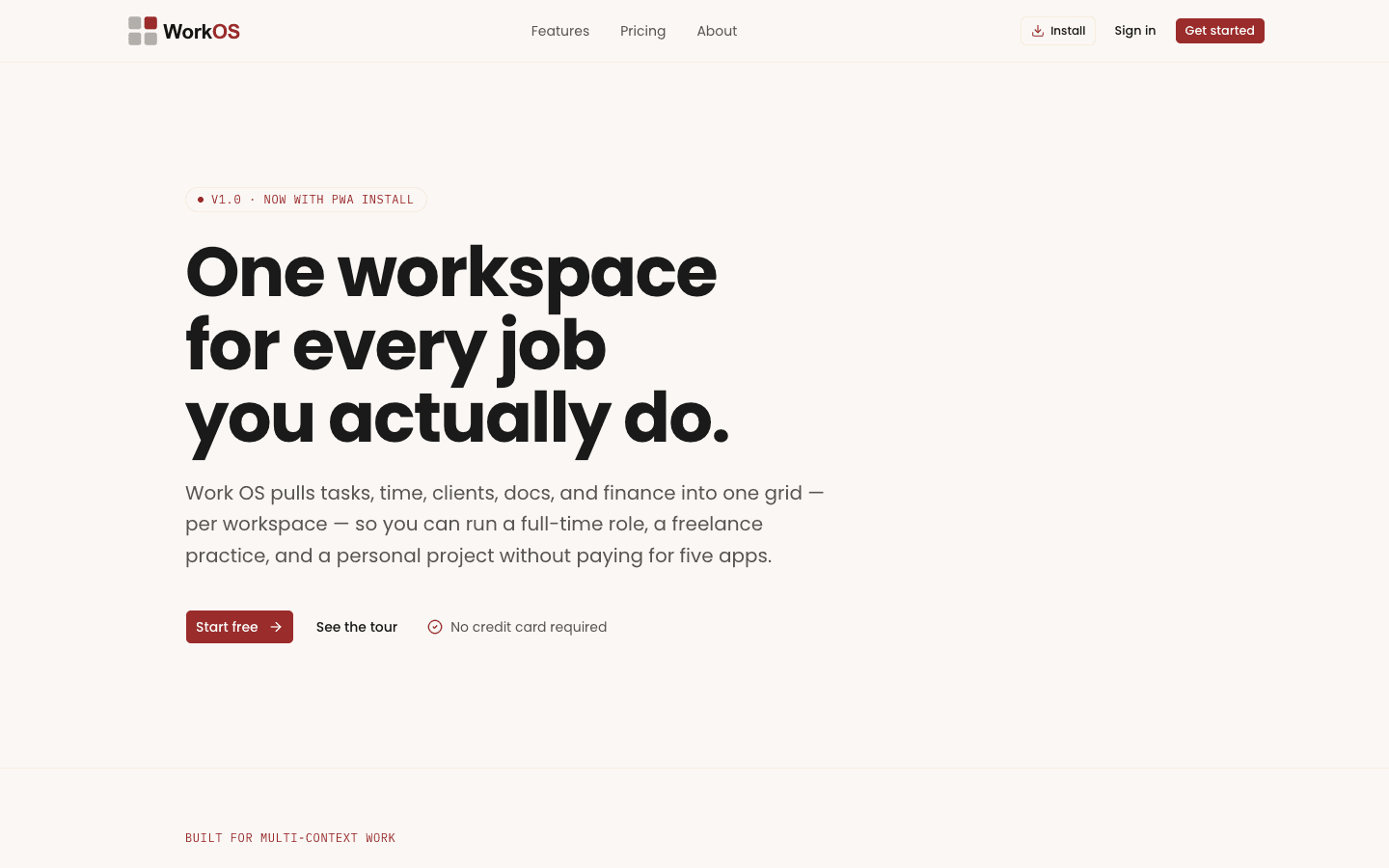
Work OS is an end-to-end workspace and project management platform architected as a modular monorepo. The web client (apps/web) is built on Next.js 15, React 19, Zustand, and React Query with offline PWA support, while the high-performance backend (apps/api) runs on FastAPI (Python) across 28 decoupled domain modules backed by PostgreSQL 16 and Redis 7. It powers real-time cross-component communication, strict schema validation, distributed caching, and end-to-end agency workflow orchestration without third-party bloat.
Highlights
- 01
Next.js 15 & React 19 frontend with Zustand state & React Query caching
- 02
FastAPI backend architecture spanning 28 decoupled domain modules
- 03
PostgreSQL 16 relational persistence & Redis 7 distributed cache layer
- 04
Monorepo package boundaries with strict cross-component data flow & PWA
fig. P.2system design
How it’s built.
One deployable API split into 28 domain modules with hard boundaries, a PWA client that caches aggressively and survives offline, and Redis doing triple duty as cache, pub/sub and job broker in front of PostgreSQL.
- Client
- Cache
- Edge / proxy
- Service
- Worker
- Database
- Platform
- async
Flow · Read · cache hit
Opening a workspace: two caches stand between the click and the database.
Design decisions
01Monolith or microservices
A modular monolith - 28 domain modules in one FastAPI deployable.
Module boundaries give the separation of services without network hops, distributed transactions or N deploy pipelines for a small team.
Trade-off · One process scales as a unit; a hot module cannot be scaled alone until it is extracted - which the boundaries make possible later.
02One Redis, three jobs
Redis 7 as cache, pub/sub bus and task broker.
One operationally simple component covers all three needs at this scale, with sub-millisecond latency.
Trade-off · Pub/sub is fire-and-forget, so clients refetch on reconnect rather than trusting every push.
03Where the client keeps state
React Query for server state, Zustand for UI state.
Server data gets caching, deduping and optimistic updates for free; local UI state stays tiny and synchronous.
Trade-off · Two state models to learn - the rule is simple: if the server owns it, it lives in React Query.
04Offline support
PWA with a precached shell and queued mutations.
Agencies work on trains and conference Wi-Fi; a project tool that blanks out loses trust.
Trade-off · Replay needs idempotent endpoints and conflict handling when two people edited the same card.